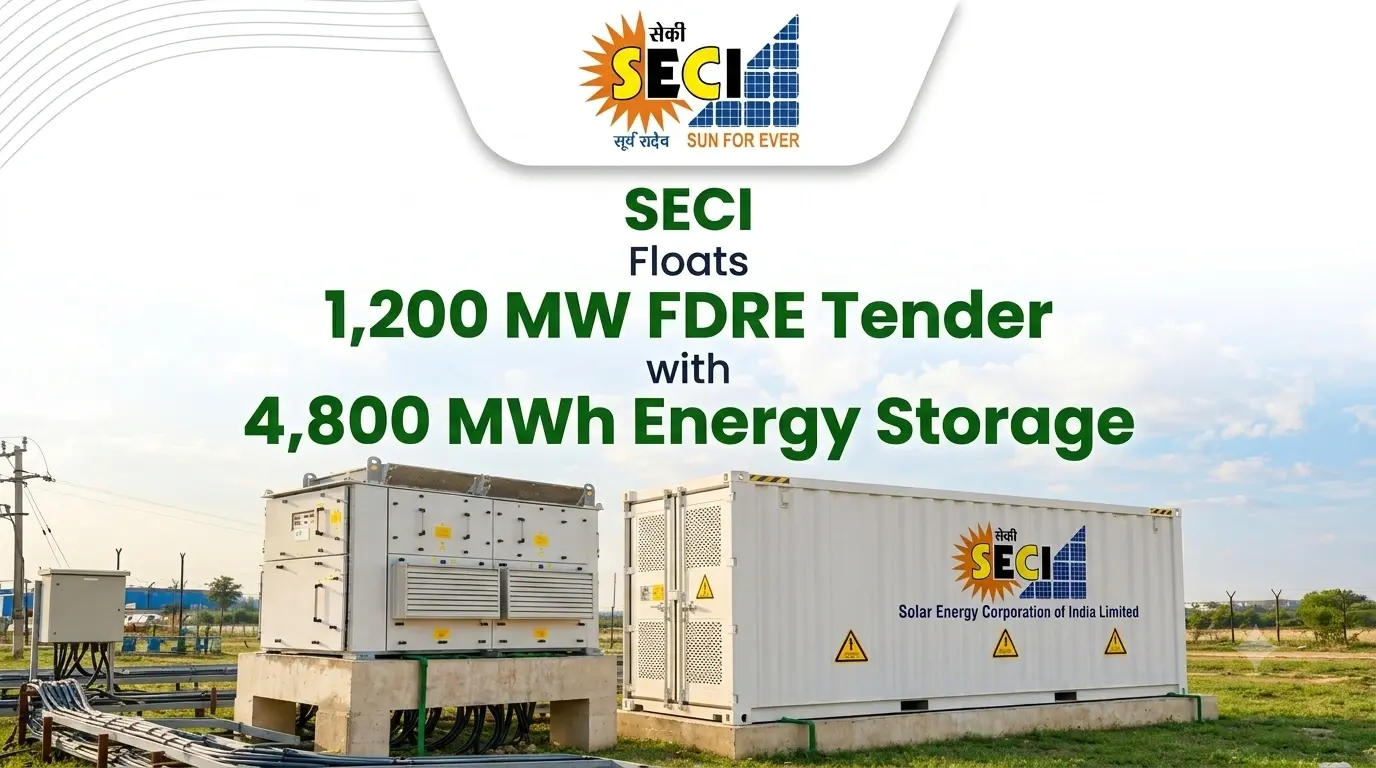
SECI has opened a 1,200 MW FDRE tender under SECI-FDRE-X to procure 4,800 MWh of assured peak renewable power. Issued on October 7, 2026, the tender mandates energy storage and a 25-year PPA, with online bid submission closing on October 29 and offline documents due by November 2, 2026.
Key Highlights
- Tender Capacity – 1,200 MW
- Peak Supply – 4,800 MWh
- Daily Supply Obligation – 4 MWh per MW
- PPA Tenure – 25 years
- Minimum Bid Size – 50 MW
- Maximum Cumulative Allocation – 600 MW
- Project Model – Build-Own-Operate (BOO)
- Online Bid Deadline – October 29, 2026
- Offline Document Deadline – November 2, 2026
- ISTS Connectivity – Minimum 220 kV
- Commissioning Timeline – 18 months
- Previous FDRE Tariff Benchmark – ₹5.99–₹6.00/kWh
The Solar Energy Corporation of India Limited (SECI), a Navratna Central Public Sector Undertaking under the Ministry of New and Renewable Energy (MNRE), has issued a Request for Selection (RfS) for the procurement of assured peak renewable power from Inter-State Transmission System (ISTS)-connected renewable energy projects across India.
Under the SECI-FDRE-X tender, SECI is seeking renewable energy developers for a total contracted capacity of 1,200 MW, backed by an assured peak supply requirement of 4,800 MWh. Selected Renewable Energy Power Developers (RPDs) will be required to supply 4 MWh of renewable energy per MW of contracted capacity every day during scheduled peak hours.
The procurement will be carried out through e-bidding followed by an e-Reverse Auction under a Build-Own-Operate (BOO) model. Developers will be responsible for establishing the renewable generation capacity, mandatory Energy Storage System (ESS), and required transmission infrastructure up to the Delivery Point.
SECI FDRE Tender Builds on ₹6/kWh Tariff Benchmark
The SECI-FDRE-X tender comes at a time when tariffs for firm and dispatchable renewable energy have become increasingly competitive.
SECI’s previous 1,500 MW FDRE procurement saw winning tariffs in the range of ₹5.99–₹6.00/kWh. FDRE tariffs have declined considerably from earlier levels of around ₹8.50/kWh, moving through ₹6.74/kWh and ₹6.27/kWh before reaching the ₹6/kWh range.
The trend reflects declining battery storage costs, better renewable-storage sizing and improved project optimization. The latest reverse auction is therefore expected to provide another important benchmark for India’s emerging firm renewable power market.
4,800 MWh Daily Peak Renewable Power Supply
The primary objective of SECI-FDRE-X is to provide renewable electricity during high-demand periods when conventional solar generation is unavailable or insufficient.
The buying entity will specify four peak hours within the applicable peak window. Developers must supply 1 MWh per MW of contracted capacity in each selected hour, resulting in a total obligation of 4 MWh/MW per day.
For example, a developer awarded 100 MW of contracted capacity would need to supply 400 MWh of renewable electricity every day during the scheduled four-hour peak period.
The tender also requires continuous power supply for at least one hour within the selected four-hour period, strengthening the reliability requirement compared with conventional renewable procurement.
Read more about :- NTPC Limited BESS Tender
Mandatory Energy Storage Gives Developers Technology Flexibility
Energy Storage Systems are mandatory under SECI-FDRE-X, but developers have flexibility in selecting the underlying technology and project configuration.
Projects can combine solar PV with BESS, wind with ESS, wind-solar hybrid generation with ESS, or other eligible renewable energy technologies with storage.
SECI has also allowed developers to optimize their installed renewable generation capacity. The installed capacity can be lower than, equal to, or higher than the contracted capacity, giving developers flexibility to oversize generation and optimize the renewable-plus-storage configuration.
The ESS can be owned directly by the RPD or tied up through a third-party storage provider. The RfS also provides flexibility regarding changes in storage technology during the PPA period, subject to applicable provisions.
Pan-India Projects Require 220 kV ISTS Connectivity
Projects under the tender can be developed anywhere in India, subject to the specified connectivity and technical requirements.
Where a single project is being considered, the renewable generation facility and ESS are required to be co-located.
The project must be connected to the Inter-State Transmission System at a minimum voltage level of 220 kV. Developers will be responsible for land, right-of-way, statutory approvals, connectivity and transmission infrastructure up to the Delivery Point.
The associated costs, transmission arrangements and applicable losses within the developer’s scope will also remain the responsibility of the RPD.
50 MW Minimum Bid and 600 MW Maximum Allocation
The minimum contracted capacity that a bidder can offer is 50 MW. At the other end, the maximum cumulative contracted capacity that can be awarded to a bidder, including eligible capacities of its parent, affiliates and ultimate parent/group entities, is 600 MW.
This structure enables participation by large renewable developers while placing a limit on the concentration of contracted capacity among individual business groups.
Shortfall Beyond Permitted Limit Attracts 1.5x Penalty
SECI has included strict performance requirements to ensure that contracted peak renewable power is actually available when required.
RPDs are permitted a specified monthly shortfall tolerance of up to 10%. Shortfall beyond the permitted threshold attracts a penalty equivalent to 1.5 times the applicable PPA tariff.
Developers can also source up to 5% of their annual renewable energy requirement from eligible green markets or bilateral green power arrangements. Such power can be used to meet peak supply obligations or charge the ESS, subject to the tender conditions.
ESS Can Be Used in Merchant Power Markets
The tender allows developers to commercially utilize storage assets outside their contracted peak-supply obligations.
ESS capacity or stored energy that is not required for the SECI obligation can be deployed in merchant markets, including power exchanges or bilateral transactions, subject to the applicable PPA and RfS provisions.
However, the SECI obligation receives priority. If an RPD diverts energy to third parties while failing to meet its contracted SECI supply, an additional penalty of 1.5 times the applicable market rate can be imposed, over and above the shortfall penalty.
PSM Requires ₹0.02/kWh Tariff Discount
The tender also provides a Payment Security Mechanism (PSM) option for developers.
Developers opting for PSM coverage are required to offer a ₹0.02/kWh tariff discount on the monthly tariff payment for the entire 25-year PPA term.
This provision will be an important consideration in the bidding strategy because developers will need to factor the 2-paise discount into their project returns and final tariff offers.
Projects Get 18 Months for Commissioning
The Scheduled Commercial Supply Date (SCSD) is set at 18 months from the Effective Date of the PPA.
Part commissioning is permitted in minimum 50 MW tranches, except for the final balance capacity. However, part commissioning does not extend the original SCSD.
An additional period of up to six months may be available for achieving full contracted supply, subject to applicable penalties. Continued delays can result in reduction of contracted capacity and termination of the PPA for the uncommissioned portion.
Financial Closure Required Six Months Before SCSD
Developers must achieve financial closure six months before the SCSD. At financial closure, bidders must demonstrate the required financing arrangements, including equity and debt tie-up, along with applicable procurement documentation for key project equipment.
The financial requirements under the tender are linked to the renewable technology and ESS configuration.
| Requirement | Solar PV | Wind & Other RE | ESS |
| Minimum Net Worth | ₹96.80 lakh/MW | ₹1.368 crore/MW | ₹24 lakh/MWh |
| EMD | ₹9.68 lakh/MW | ₹13.68 lakh/MW | ₹2.40 lakh/MWh |
| PBG | ₹24.20 lakh/MW | ₹34.20 lakh/MW | ₹6 lakh/MWh |
In addition, bidders must meet the prescribed liquidity criteria through either an annual turnover of ₹78.7625 lakh/MW of quoted contracted capacity or the specified PBDIT requirement of ₹15.7525 lakh/MW, subject to the RfS provisions.
Selected developers will also be required to pay success charges of ₹1 lakh/MW plus applicable taxes, calculated in accordance with the RfS.
SECI-FDRE-X Could Accelerate India’s Firm Renewable Market
SECI-FDRE-X marks another step in India’s transition from conventional renewable capacity procurement toward firm, dispatchable and time-specific renewable power.
The 1,200 MW tender combines renewable generation with mandatory storage and a four-hour daily peak supply obligation. As a result, project competitiveness will depend not only on solar and wind generation costs but also on BESS sizing, battery degradation, cycling strategy, transmission availability, financing costs and merchant-market optimization.
For renewable developers, BESS manufacturers, EPC companies and investors, SECI-FDRE-X could become an important benchmark for the next phase of India’s firm and dispatchable renewable energy market.