Prime Minister highlights ₹20 lakh crore investment opportunities, 200 GW-plus solar module manufacturing capacity, green hydrogen expansion and battery storage innovation.
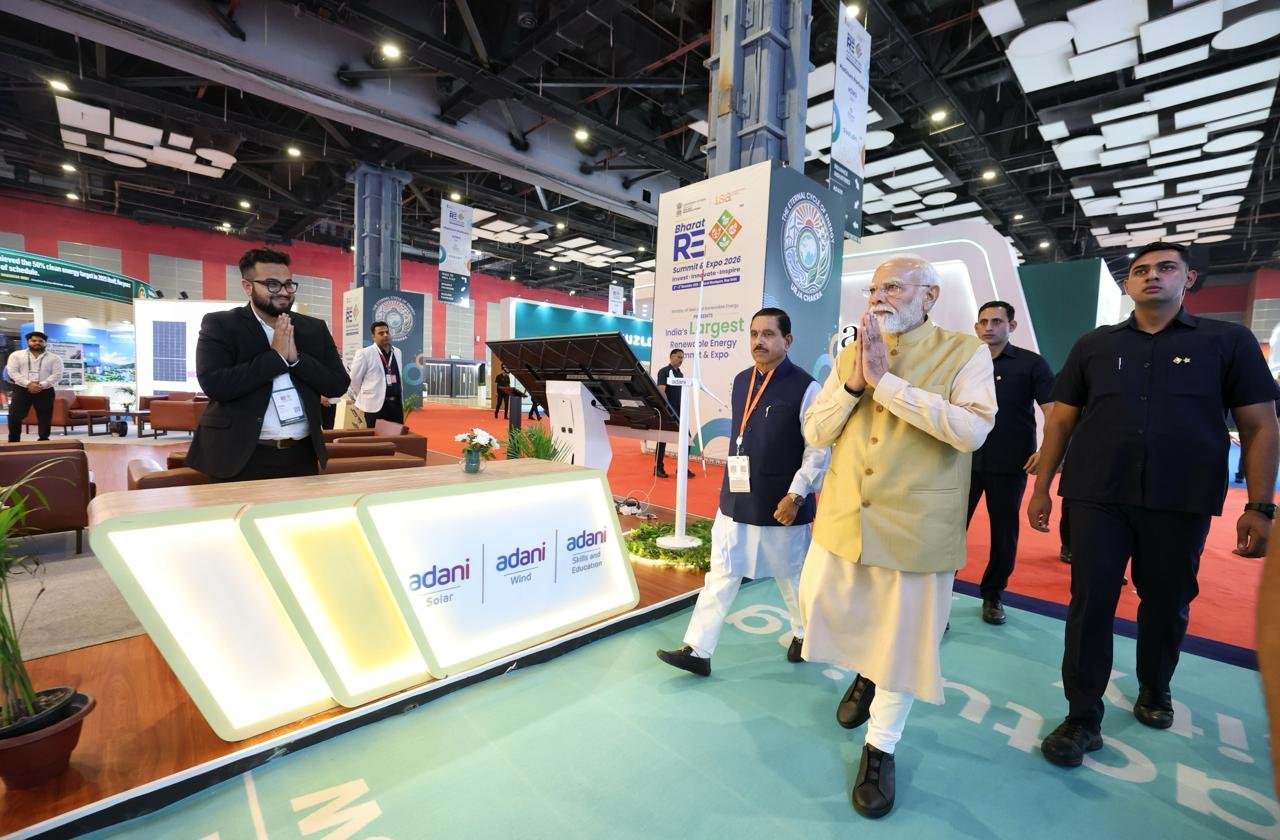
Prime Minister Narendra Modi inaugurated the Bharat Renewable Energy Summit & Expo (Bharat RE 2026) at Bharat Mandapam in New Delhi on November 2, outlining India’s next phase of clean energy expansion, domestic manufacturing and investment opportunities. The four-day summit, being held from November 2 to 5, carries the theme ‘Invest. Innovate. Inspire.’
Addressing industry leaders, investors, international delegates, and innovators at the Bharat Renewable Energy Summit 2026, the Prime Minister said recent global energy disruptions have reinforced the importance of energy security and reduced dependence on fossil fuels. He stated that India’s investments in clean energy over the past decade have helped the country manage external economic challenges effectively.
Key Targets Outlined at Bharat Renewable Energy Summit 2026
Highlighting India’s renewable energy progress, PM Modi said the country achieved its commitment to source 50% of installed electricity capacity from non-fossil sources in 2025, five years ahead of its scheduled timeline.
India has already achieved nearly 300 GW towards its 500 GW non-fossil capacity target for 2030. The Prime Minister announced an ambition to add another 500 GW of non-fossil capacity over the next 10–11 years.
He also emphasised that the future of energy security lies in clean energy, including solar, wind, hydro, nuclear and emerging renewable technologies.
Rooftop Solar and Agricultural Applications
The Prime Minister highlighted the progress of the PM Surya Ghar Muft Bijli Yojana, launched in February 2024 with a target of installing rooftop solar systems in one crore households. More than 65 lakh households have joined the programme, with approximately one lakh new households being added every six days.
According to figures cited in his address, the scheme has helped reduce electricity bills by around 76%, while some households are earning additional income by selling surplus electricity to the grid.
He also highlighted solar installations across more than 44,000 government buildings, generating annual savings of nearly ₹700 crore. Under PM-KUSUM, more than 30 lakh farmers have received support for solar irrigation.
Green Hydrogen, Transmission and Energy Storage
India is targeting annual green hydrogen production of 50 lakh tonnes by the end of the decade under the National Green Hydrogen Mission. The Prime Minister also highlighted the introduction of India’s first green hydrogen-powered train.
On grid infrastructure, he discussed Green Energy Corridors, transmission lines and substations required to transfer renewable electricity from generation centres to demand locations. He referred to an investment target of approximately ₹2 lakh crore for strengthening transmission infrastructure.
PM Modi also called for greater innovation in battery storage technologies, indigenous storage hardware and next-generation energy storage systems to support increasing renewable energy integration.
Solar Manufacturing Capacity Exceeds 200 GW
Highlighting domestic manufacturing growth, the Prime Minister said India’s solar module manufacturing capacity has increased from approximately 2 GW a decade ago to more than 200 GW, while solar cell manufacturing capacity has reached nearly 40 GW.
He linked the expansion with the Make in India and Atmanirbhar Bharat initiatives, noting the importance of strengthening domestic clean energy supply chains.
₹20 Lakh Crore Investment Opportunity
PM Modi stated that India’s renewable energy sector attracted more than ₹15 lakh crore in investments over the past decade, including over ₹6 lakh crore in the two years following the 2024 RE-INVEST Summit.
Investment opportunities in India’s clean energy sector are projected to exceed ₹20 lakh crore by the end of this decade.
He also highlighted a proposed $200 million Africa Solar Facility to support international solar energy development through financing, technology and expertise.
The summit brings together participants from more than 130 countries and coincides with the Ninth Assembly of the International Solar Alliance and the Fourth International Conference on Green Hydrogen.
The Prime Minister urged startups, researchers, investors and manufacturers to accelerate innovation in household solar applications, electric mobility, agricultural equipment and energy storage, stating that the coming decade will be important for India’s clean energy transition.
The Bharat Renewable Energy Summit 2026 brings together participants from more than 130 countries.