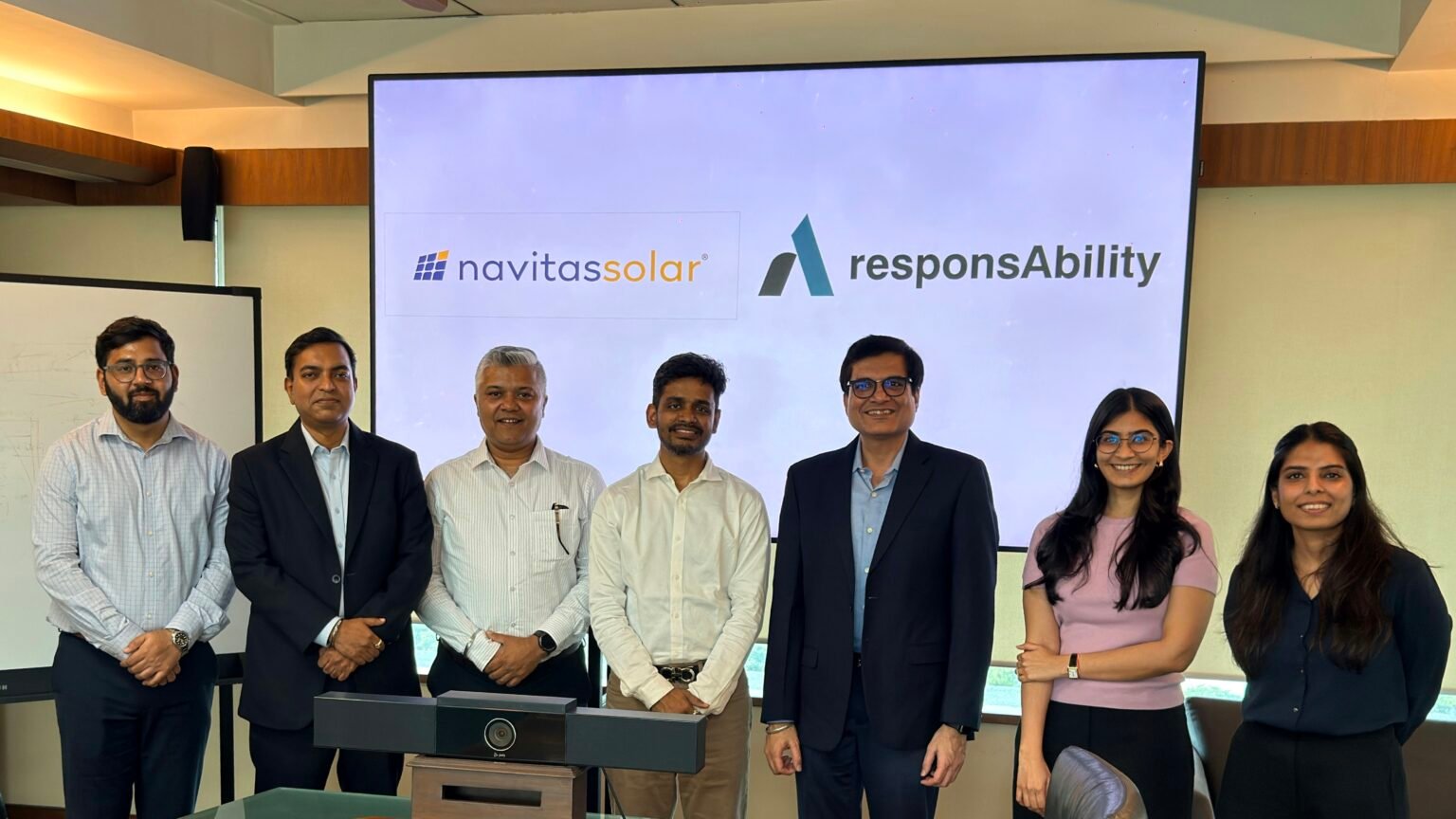
Navitas Solar has secured up to $20 million in growth capital from Swiss impact asset manager responsAbility to support its planned 2.2 GW solar cell manufacturing facility and advance its backward integration strategy
Key Highlights
- Investor – responsAbility Investments AG (Asia Climate Fund)
- Company – Navitas Solar
- Investment Amount – Up to US$20 Million
- Planned Cell Facility – 2.2 GW Solar Cell Manufacturing Plant
- Strategic Roadmap – Backward Integration into Solar Cells, Wafers and Ingots
- Financial Adviser – Centrum Capital (Infrastructure Advisory)
- Headquarters – Surat, Gujarat
- Product Range – Mono PERC and N-Type TOPCon Solar Modules (40 Wp–720 Wp)
Navitas Solar, a Surat-based integrated renewable energy manufacturer, has secured growth capital of up to US$20 million from Swiss impact asset manager responsAbility. The capital injection is slated to support the company’s backward integration roadmap, centered on a planned 2.2 GW solar cell manufacturing facility in India.
The investment is backed by responsAbility’s Asia Climate Fund, an initiative dedicated to financing scalable private-sector enterprises targeting measurable carbon dioxide (CO₂) emission reductions and long-term societal impact in high-growth markets. Centrum Capital’s Infrastructure Advisory division acted as the exclusive financial adviser to Navitas Solar for the transaction.
Welcoming the partnership, Vineet Mittal, Director at Navitas, noted that the capital arrives at a critical juncture:
“We are pleased to welcome responsAbility as an institutional partner in the next phase of Navitas’s journey. Their investment is important not only as growth capital, but also because of the strong alignment between our long-term objectives.”
Strategic Expansion into Solar Cell Production
Founded in 2013 and headquartered in Surat, Gujarat, Navitas Solar has gradually built a multi-segment portfolio encompassing solar module manufacturing, encapsulant production (EVA/POE), engineering, procurement and construction (EPC) services, battery energy storage systems (BESS), and renewable power generation. Its current module portfolio features Mono PERC and high-efficiency N-type TOPCon modules ranging from 40 Wp to 720 Wp.
The planned 2.2 GW solar cell facility marks a decisive transition toward domestic upstream control. By producing its own cells, Navitas aims to insulate its manufacturing lines from global supply chain volatility and strengthen product margins.
Highlighting the rationale behind the investment, Jay Bathija, Principal, Climate Infrastructure Investments at responsAbility, stated:
“Navitas’ expansion into cell manufacturing is a natural next step that will deepen integration across the solar value chain and can strengthen its long-term competitiveness.”
Upstream Ambitions: Wafers and Ingots
Navitas Solar’s long-term roadmap extends beyond cell fabrication into silicon wafer and ingot manufacturing. These primary stages sit at the foundational end of the crystalline silicon supply chain, directly upstream of cells and modules.
The planned multi-stage integration aligns with India’s broader push to build an end-to-end domestic clean energy manufacturing ecosystem, reducing dependence on component imports from overseas markets.
While the cell facility and further upstream ambitions remain subject to phased development and execution milestones, the growth capital provides Navitas with the institutional backing needed to scale its operations across critical links of the clean energy supply chain.